




Congratulations on choosing to play the clarinet. Whether you are new to playing music in general, new to the clarinet, or a parent of a music student, you will want to know these basics soon after receiving your instrument.
Parts of the Clarinet
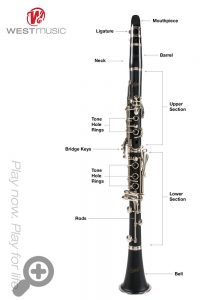
Click the image to zoom in.
Assembling Your Clarinet
Your instrument should be handled with care. Follow these instructions or the instructions given to you by your music director to prevent damaging the instrument.
- Place the thin end of the reed into your mouth or a container of water to moisten it.
- Place your case on a steady surface right side up and open it carefully.
- If needed, place a small amount of cork grease on each cork. Clean your hands after applying.
- Gently twist the bell onto the lower section of the clarinet without squeezing the rods.
- Hold the upper section in your left hand and press down on the tone hole rings. Twist the upper section into the lower section. Be sure to line up the tone holes and bridge keys.
- Gently twist the large end of the barrel onto the upper section.
- Remove the mouthpiece cap and ligature. Twist the mouthpiece into the barrel. Be sure to line up the flat part of the mouthpiece with the register key.
- Add the ligature to the mouthpiece, then slide the thick end of the reed against the mouthpiece with the flat side against the rectangular opening. The reed should be centered and not extend above the top of the mouthpiece. Gently tighten the ligature screws to hold the reed in place.
Below is a clip from Alfred Music going over each of these steps. Alfred Music is the publisher of the popular Sound Innovations method book series for beginner students.
[su_youtube url=”https://youtu.be/Y_EKz9ATfDg” width=”360″ height=”240″]
Putting It All Away
- Remove the ligature and reed from the mouthpiece.
- Place the reed in a reed case. This helps it dry properly and last longer.
- Disassemble in reverse order of assembly. Use the swab to dry the inside of the instrument. Wipe off the outside with a soft cloth.
- Carefully place the instrument in the case and close all the latches.
- Store only your instrument and its accessories in the case. Sheet music, folders, and other objects may bend the keys and damage the instrument.
Related Articles
- How to Hold Your Instrument: Woodwind – Tips & Reminders
- 10 Care Tips for Woodwind Instruments
- 7 Tips for Practicing
- Practice Tips for Young Musicians
Have questions? Need advice? West Music is here for you! Give our school band experts a call at 800-373-2000.
Adapted from Alfred Music’s Sound Innovations for Concert Band 1: Clarinet.
Special thanks to our partners at Alfred Music for providing us smartmusic® videos and additional materials.
Aaron Hansen is an experienced K-6 General Music educator, passionate about bringing music to life through the Orff Approach. He holds both a Bachelor’s and a Master’s degree in Music Education from the University of Northern Iowa. Aaron has completed comprehensive Orff Teacher Training, including three levels at the University of St. Thomas and an Orff Master Class. His dedication to the Orff method took him to the Summer International Course at the Orff Institute in Salzburg, Austria. Aaron also shares his expertise by teaching movement at various Orff Teacher Training Courses and conducting workshops for local Orff Chapters.


