



Guide to the gauge of each string (from 6th to 1st)
6- A ( .098 ) STEEL/BRONZE WOUND
5- D ( .075 ) STEEL/BRONZE WOUND
4- G ( .055 ) STEEL/BRONZE WOUND
3- C ( .105 ) NYLON WOUND
2- E ( .070 ) NYLON WOUND
1- A ( .055 ) NYLON WOUND
Playing the Guitarrón
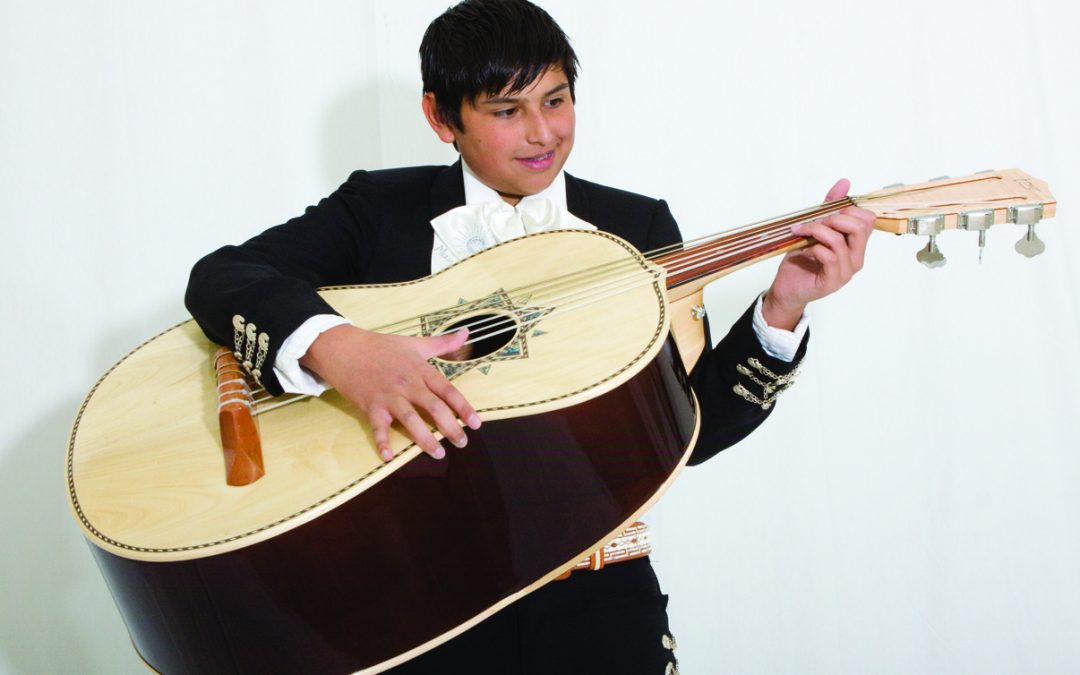
Are you wondering how to play the Guitarron? The sound produced by pulling the strings is loud and powerful. This instrument has a distinctive timbre quality that is warm and colorful. The large hollow-body, with the convex back, enhances the lower frequencies thus producing a rich bass sound. The fingerboard (el díapson) is fretless, and the tuning mechanism can be metal machine heads or wooden pegs (the wooden pegs are called las clavijas). The strings are of heavy gauge, and the tension is firm. An exceptional and specific left-hand technique is required to depress the strings. Support, clarity, and intonation are essential when producing the desired notes being played. Left-hand strength would be desirable but not necessary. The right hand is used for plucking or pulling (el jalón) two strings simultaneously near the sound hole of the Guitarrón. When the two strings are played together for each written note, they are played in octaves. Pulling on a single string instead of double stringing can also produce warmth and color of the notes played. The fretless fingerboard is used to depress the string (to stop) with the fingers in certain positions thus producing the notes desired.
Function in the Mariachi Ensemble
The role of the Guitarrón functions as the backbone of the mariachi ensemble. It provides the bass line, the primary rhythmic pulse and primary musical guide along with the Vihuela Mexicana and the guitar. These instruments together commonly referred to as the rhythm section or las armonías. It is interesting to note that the Guitarrón eventually replaced the harp as a bass instrument. The Guitarrón was the instrument preferred by the mariachi musicians in central Jalisco.
Aaron Hansen is an experienced K-6 General Music educator, passionate about bringing music to life through the Orff Approach. He holds both a Bachelor’s and a Master’s degree in Music Education from the University of Northern Iowa. Aaron has completed comprehensive Orff Teacher Training, including three levels at the University of St. Thomas and an Orff Master Class. His dedication to the Orff method took him to the Summer International Course at the Orff Institute in Salzburg, Austria. Aaron also shares his expertise by teaching movement at various Orff Teacher Training Courses and conducting workshops for local Orff Chapters.


