



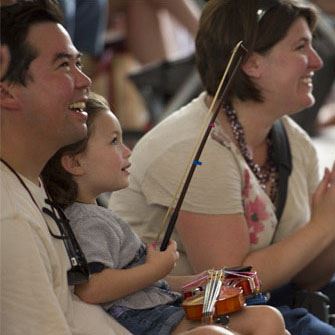
Research presented from many professional education sources confirms that family involvement is a key element of excellence in learning. Students have more opportunities to be successful and to have meaningful experiences when their families are involved. Music becomes a link to the whole person, not just a set of tasks and assignments designed to create proficiency, but a true conversation with ourselves and our world.
Discussion about our philosophies and practices are centered around the following agenda bullet points:
Motivation – Inspiration: Teachers who share their own playing with students become role models for burgeoning musicianship. Through witnessing teacher performances, our students can see that hard work achieves goals. Our teachers lead by example and show more/tell less. Families that watch us play are assured that their students are in capable hands.
Listening – Direct Response: The old teaching archetype of commanding students and expecting silent obedience is not usually healthy. An effective way to gain ground instead is to make the instruction a dialogue. Our teachers ask students for feedback about their experiences and respond directly, both with words and with curricula/playing tactics. We extend our questions and comments to younger students’ families between lessons and use the feedback to assist with challenges and boost success.
Bridge Building: What links our studio to your students’ homes? Studio events like recitals and receptions, newsletters and regular communications, marketing materials like refrigerator magnets, etc will keep the lesson program at the front of family perspectives.
Clear Expectations: Students are more likely to follow a specific direction when it is clear and to the point. Think about the difference between saying to a student “Work hard on that and it will be better” or saying “Keep your thumb firmly on the back of your instrument while curving your wrist forward. Practice this motion five times before playing any song.” Specificity and clarity in what we ask from students and their families will secure a positive outcome.
Praise Effort / Reward Results: Teachers have a difficult balance to keep in needing to both provide encouragement and instill discipline. If the balance is tilted away from discipline our students can under-develop their intrinsic motivation. If the balance is tilted away from encouragement we risk high levels of frustration and even possible resentment of music. It is important to remember that what we say and how we say it have a big impact. Rewards, even simple paper printings, stickers on a chart or treats are the most effective when they are associated with a specific result. If these rewards follow our students home they become part of a bridge building system with families too.
Aaron Hansen is an experienced K-6 General Music educator, passionate about bringing music to life through the Orff Approach. He holds both a Bachelor’s and a Master’s degree in Music Education from the University of Northern Iowa. Aaron has completed comprehensive Orff Teacher Training, including three levels at the University of St. Thomas and an Orff Master Class. His dedication to the Orff method took him to the Summer International Course at the Orff Institute in Salzburg, Austria. Aaron also shares his expertise by teaching movement at various Orff Teacher Training Courses and conducting workshops for local Orff Chapters.


